The U.S. Marine Corps this month tested a new way to give ground commanders long-range reconnaissance and strike capabilities by experimenting with a medium-sized drone that can launch a separate, one-way attack drone in what the service said was its first regimental-level assessment.
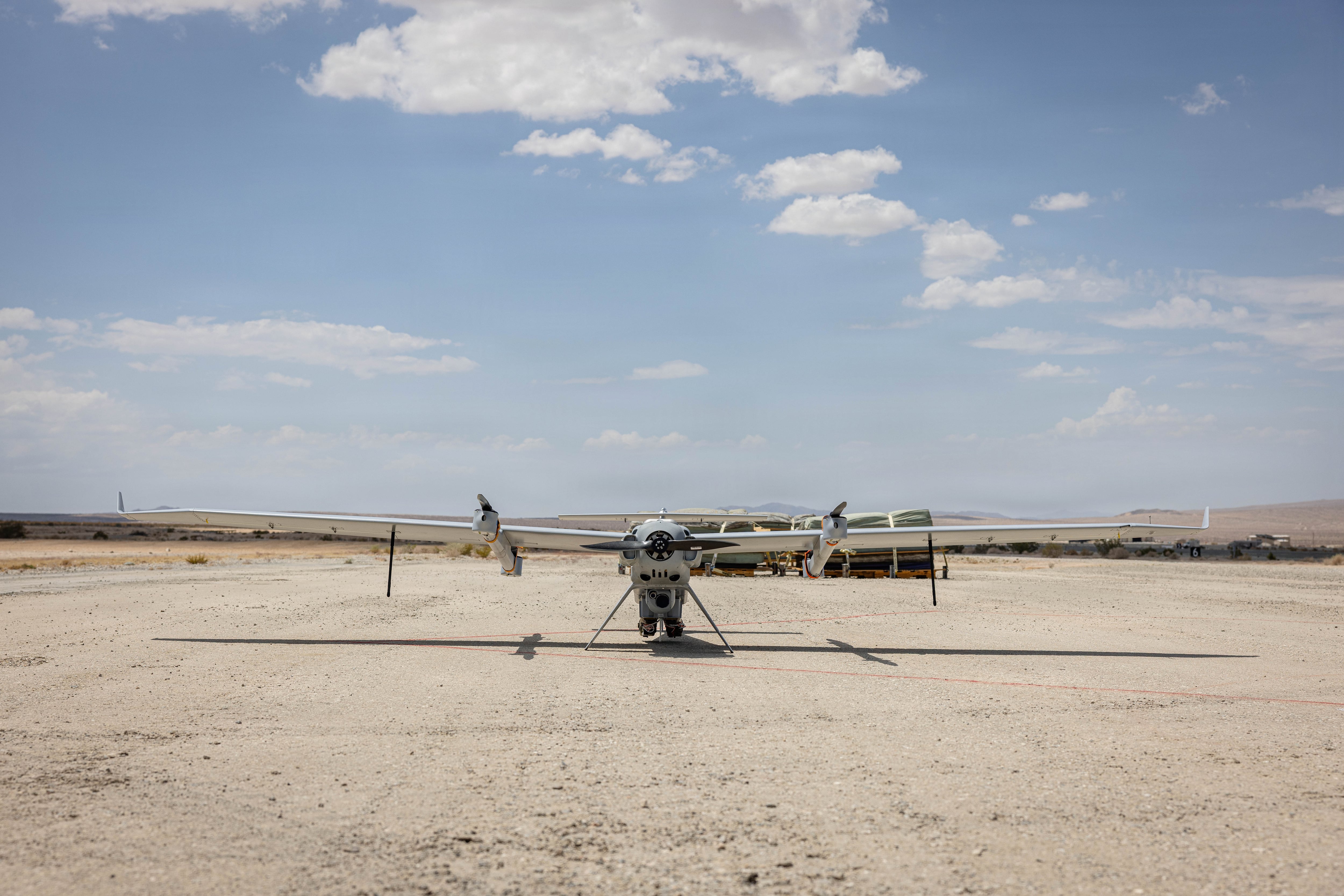
During a training exercise in Twentynine Palms, California, 2nd Marine Regiment paired AeroViroment’s JUMP 20-X with the company’s Switchblade 300 Block 20 loitering munition, a move that could eventually give regiments capabilities beyond the short-range drones currently fielded by the formations.
The JUMP 20-X is a medium-sized unmanned aircraft that is classified as a Group 3 drone. It is capable of remaining airborne for up to 12 hours and carrying a payload of 30 pounds. During the experiment, it launched the Switchblade, which the Marine Corps said struck a target more than 15 miles away.
“[The Marine Corps has] the Marine Unmanned Aerial Vehicle Squadrons 1, 2, and 3 that fly the MQ-9s in the Group 5 level of assets, but it would be great for the Regiment because we’re outside of the [air] wings,” said Chief Warrant Officer Two Christopher Leone in the service’s release. “We’re supporting the Ground Combat Element that doesn’t have an asset that can fly as far as the Group 5, so this is something that hasn’t been tested before.”
Currently, the regiment only has Group 1 drones, which stay airborne for far less time — typically between 30 and 90 minutes — and operate over much shorter distances. The July tests evaluated whether a larger drone could lengthen the regiment’s reach.
AeroVironment personnel flew the JUMP 20-X while Marines observed because the unit does not have Marines trained to fly Group 3 drones.
The experiment comes as the Marine Corps this month also announced the creation of a new small drone training unit, a move that underscored the integral role drones are now playing in modern warfare.
Eve Sampson is a reporter and former Army officer. She has covered conflict across the world, writing for The New York Times, The Washington Post and The Associated Press.